
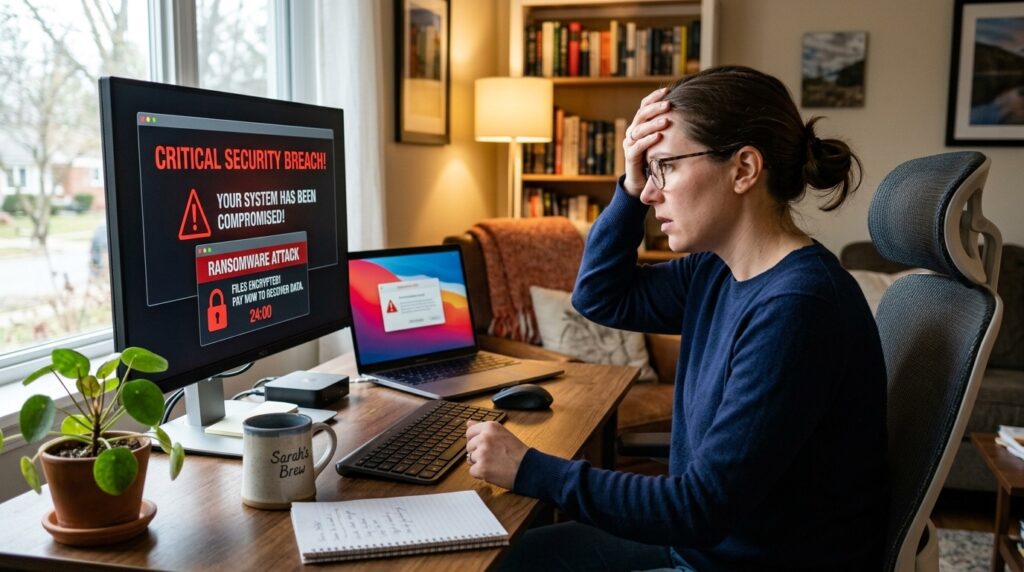
The Office Has Left the Building
Walk through a typical Gold Coast business today and you’ll find something the IT department from 2019 never planned for. Half the team is at their kitchen table in Merrimac. The bookkeeper works Tuesdays from a Broadbeach cafe. The sales manager just logged in from Southport on the same laptop his teenagers use for gaming.
This is not a problem to solve. It’s the new normal. According to the Australian Government’s own Cyber Security Industry Advisory Committee, Australia’s remote workforce grew from 8% to 40% during the pandemic and it has not returned to pre-2020 levels. More than 72% of workers who can work remotely now prefer a hybrid arrangement. Only 9% want to return to the office full time.
The business case for hybrid work is solid. Productivity improves. Overheads fall. Talent pools expand. NAB documented a 10% productivity increase after committing to hybrid as a permanent model.
But every kitchen table, every cafe login and every shared family laptop represents a security exposure that cybercriminals are actively exploiting. And most Gold Coast SMBs are not ready for it.
Why Hybrid Work Is a Cybercriminal’s Favourite Development
The numbers are not comfortable reading. In 2025, 92% of IT professionals globally reported that remote and hybrid work directly increased their organisation’s cybersecurity threat exposure. Phishing accounts for 43% of all initial breach attempts in remote environments. Twenty-nine percent of ransomware attacks now originate from home office entry points. Credential theft has increased significantly, with 54% of chief information security officers reporting a rise in remote access credential incidents.
For Australian businesses specifically, the Australian Signals Directorate received 84,700 cybercrime reports in 2024-25, roughly one every six minutes. That is not a distant risk. It is a daily reality.
The reason hybrid work creates such vulnerability is architectural. A traditional office runs all traffic through managed, monitored infrastructure. A home office does not. When your accounts payable manager connects from a domestic router shared with streaming devices, smart speakers and personal phones, your organisation’s financial data is travelling through equipment you have never assessed, patched or configured.
A telecommunications integration SME with around 120 Australian employees discovered this the hard way. A single phishing email led to malware deployment that brought operations to a halt for three months. Before the attack, staff could download software freely and use work devices for personal business. Backups were not being completed. Recovery was slow and expensive. As their Finance Manager noted afterward: “We thought we were protected and didn’t realise how vulnerable we were.” [Source: Australian Government Hybrid Workforce Cybersecurity Report]
The Four Pressure Points in Every Hybrid Environment
Understanding where hybrid work creates risk is the first step toward managing it intelligently.
Unsecured home networks and personal devices. Domestic routers rarely receive firmware updates. Default passwords remain active for years. Every IoT device on the same network, from smart TVs to robot vacuums, represents a potential lateral entry point. Research shows 22% of endpoint weaknesses exploited in remote settings involve personal or unmanaged devices.
Credential exposure through phishing and weak authentication. Remote workers receive more digital communication than office-based staff, increasing both fatigue and exposure. Sixty-two percent of security breaches involve poor or stolen remote access credentials. AI-generated phishing emails are now indistinguishable from legitimate correspondence, particularly targeting accounts payable and executive assistants.
Shadow IT and unsanctioned applications. When employees cannot easily access approved tools from home, they improvise. They share documents through personal cloud accounts, communicate via consumer messaging apps and store client files on personal drives. Fifty-one percent of IT administrators report difficulty monitoring data flows across cloud tools used by remote teams. Shadow cloud account usage grew 26% in 2025 alone.
Misconfigured VPNs and cloud access points. Fourteen percent of remote data leaks result from misconfigured VPNs. The ACSC noted in joint advisory with the FBI, CISA and the UK’s NCSC that four of the most targeted vulnerabilities in 2020 involved remote work, VPNs or cloud technologies. Many organisations have not revisited their remote access configurations since the rushed pandemic deployments of 2020.
What Enterprise-Grade Security Actually Means for a Gold Coast SMB
Enterprise-grade security does not require an enterprise budget. It requires a deliberate, layered approach that extends the same standards you apply inside the office to every location your team works from.
The ACSC’s Essential Eight provides the baseline. Implementing five of these eight controls reduces successful attacks by approximately 85%. For hybrid environments, three controls are non-negotiable starting points.
Multi-factor authentication for every access point. Passwords are not enough. MFA blocks 99.9% of automated credential attacks according to Microsoft research. In 2025, 91% of organisations that implemented mandatory MFA for all remote access points reported measurable reduction in unauthorised access incidents. Hardware security keys and authenticator apps outperform SMS codes, which remain vulnerable to SIM-swapping attacks.
Endpoint Detection and Response across all devices. Traditional antivirus detects known threats. EDR monitors behaviour in real time, identifying suspicious file encryption, unusual network connections and lateral movement before damage spreads. Only 57% of organisations currently have EDR deployed across remote device fleets. The gap represents significant exposure.
Regular patching and update discipline. A 2019 Ponemon Institute report found that 60% of organisations that experienced data breaches attributed them to failure to patch known vulnerabilities. Unpatched remote devices are open doors. Automating updates across all endpoints removes human delay from the equation.
The Role of Managed IT in Securing the Hybrid Workforce
This is where managed IT services become the practical answer rather than a theoretical recommendation.
Most Gold Coast SMBs do not have dedicated security staff. The business owner, practice manager or office administrator handles IT matters between their actual responsibilities. In a hybrid environment, that approach creates compounding risk. Security tasks that require consistent, proactive attention get postponed, forgotten or handled incorrectly under time pressure.
A managed IT provider changes that equation fundamentally.
24/7 monitoring across every endpoint. Whether your team is in the office, working from Southport or logging in from a hotel in Sydney, a managed IT provider monitors all devices and access points continuously. Suspicious login attempts, unusual file transfers and anomalous behaviour trigger immediate alerts and responses, not next-week reviews.
Zero Trust implementation without internal expertise. Zero Trust architecture, where every user, every device and every access request is verified regardless of network location, is becoming the security baseline for 2026. Sixty-three percent of organisations had adopted Zero Trust models by 2025. Implementing it correctly requires configuration expertise that most SMBs do not have in-house. A managed IT provider deploys and maintains this architecture as part of ongoing service.
Consistent policy enforcement across all devices. BYOD policies, software restrictions, encrypted communications and VPN configuration need to be applied uniformly. A single unmanaged personal laptop connecting to your network creates a gap that negates every other control. Managed IT ensures policies are enforced, not merely documented.
Rapid incident response when things go wrong. If a staff member clicks a phishing link at 11pm, the response cannot wait until Monday morning. Managed IT providers offer rapid containment, system isolation and recovery support around the clock. For the telecommunications SME mentioned earlier, the absence of this capability turned a manageable incident into three months of operational shutdown.
Staff training that actually changes behaviour. The weakest link in any security program is people, not technology. Research confirms that awareness alone does not change behaviour. Effective training requires short, regular sessions focused on real scenarios, immediate relevance and positive reinforcement of near-miss reporting. Managed IT providers deploy phishing simulations, interactive micro-training and ongoing education programs as part of their service scope.
Hybrid Security Audit Checklist
Use this checklist to assess your current hybrid security posture. Any “No” answer represents an active risk requiring attention.
Identity and Access
- MFA is enforced on all email accounts including shared inboxes
- MFA is enforced on all cloud applications including file storage and accounting software
- All remote access passwords are unique and at least 14 characters
- Default passwords have been changed on all systems and devices
- Admin accounts are separate from standard user accounts
- Access privileges are reviewed when staff change roles or leave
Devices and Endpoints
- All work devices have current operating system and application updates applied
- EDR software is installed and monitored on all devices including remote machines
- Remote wipe capability is configured on all devices containing company data
- Personal devices accessing company systems are enrolled in device management
- Lost or stolen device reporting and response procedure exists and is documented
Network and Remote Access
- Staff are instructed not to use public Wi-Fi for work without a VPN
- VPN configuration has been reviewed and updated in the past 12 months
- Home router firmware update guidance has been provided to remote workers
- All cloud applications in use have been approved and inventoried
- Shadow IT apps have been identified and either approved or prohibited
Data Protection
- Backups run daily and include all remote endpoints
- Backups have been tested for restoration in the past 90 days
- Sensitive documents are stored on approved platforms only
- Data classification policy exists covering what can be accessed remotely
- File sharing to personal accounts is restricted or prohibited
People and Policy
- All staff have completed cybersecurity awareness training in the past 6 months
- A specific remote work security policy exists and has been signed by all staff
- Staff know how to report a suspected phishing email or security incident
- A no-blame near-miss reporting culture is actively encouraged
- Accounts payable and executive assistants receive targeted phishing training
Monitoring and Response
- All systems generate security logs that are actively monitored
- An incident response plan exists covering hybrid and remote scenarios
- After-hours security monitoring is in place or contracted
- Quarterly security reviews are scheduled and conducted
- New remote workers receive security onboarding before accessing company systems
Score your results. Twenty-five or more checked items indicates a reasonable baseline. Fewer than fifteen checked items indicates significant exposure requiring immediate attention. Any unchecked items in the Identity and Access or Monitoring and Response sections represent priority actions regardless of your overall score.
The Cost of Getting This Wrong
Prevention is consistently cheaper than recovery. The average cost of a data breach in Australia now exceeds $80,850 for SMBs, and that figure does not capture the full operational impact of downtime, client notification obligations under the Privacy Act, reputational damage or the staff hours consumed by incident management.
A managed IT service covering endpoint monitoring, security management and staff training typically costs very little compared against an average breach cost of $80,850. The mathematics of prevention are not complicated.
The harder question is not whether your business can afford managed IT security. It is whether you can afford the alternative.
DocSol works with you to implement enterprise-grade security across hybrid workforces without the complexity or cost of building an in-house IT team. Contact us for a hybrid security assessment tailored to your business.
Sources: Australian Government Cyber Security Industry Advisory Committee: Back to Business Hybrid Workforce Report; Australian Signals Directorate Annual Cyber Threat Report 2024-25; ElectroIQ Remote Work Cybersecurity Statistics 2026; Exigo Tech Secure Remote Work Guide for Australian SMBs 2026; Ponemon Institute Vulnerability Response Report; Microsoft Security MFA Effectiveness Research; ACSC Essential Eight Framework