How Epson’s EcoTank and Konica’s Carbon Neutral Goals Are Reshaping Gold Coast Business
The conversation around sustainable printing has shifted. Five years ago, business owners nodded politely when consultants mentioned eco-friendly printing, then promptly chose the cheapest option. Today, businesses are discovering that sustainability and profitability aren’t opposites. They’re partners.
The numbers tell the story. Businesses adopting sustainable printing solutions reduce waste by up to 50% and cut energy consumption by 30% or more. They’re not just saving the planet. They’re saving thousands of dollars annually while strengthening their brand reputation in an increasingly environmentally conscious market.
The Business Case for Green Printing
Australia’s sustainable printing market generated $31.2 million in revenue in 2024 and is projected to reach $46.8 million by 2030. This growth isn’t driven by guilt or regulation alone. It’s driven by economics. Sustainable printing technologies have reached a tipping point where they deliver superior financial returns compared to traditional alternatives.
Consider the total cost of ownership over three years. A traditional laser printer might cost less upfront, but the ongoing expenses tell a different story. Toner cartridges, drum replacements, fuser units, energy consumption and disposal costs accumulate rapidly. Meanwhile, modern sustainable alternatives use fewer consumables, require less maintenance and consume significantly less electricity.
The shift is particularly pronounced in Queensland, where rising energy costs make efficiency improvements directly visible on monthly utility bills. For businesses printing thousands of pages monthly, the difference between heat intensive laser technology and energy efficient inkjet systems translates to hundreds of dollars in electricity savings alone.
Epson’s EcoTank Revolution
Epson fundamentally redesigned how businesses think about ink delivery. Traditional inkjet printers used small cartridges that delivered perhaps 200 to 300 pages before replacement. Businesses replaced cartridges constantly, generating plastic waste and administrative overhead. The cost per page remained stubbornly high.
EcoTank printers flip this model entirely. Instead of cartridges, they feature large refillable ink tanks built into the printer. A single set of ink bottles delivers thousands of pages before refilling becomes necessary. The cost per page drops by up to 90% compared to traditional cartridge based systems.
The environmental impact is equally dramatic. A typical business printing 5,000 pages monthly would discard approximately 20 plastic cartridges annually using traditional technology. With EcoTank, that same business uses perhaps four ink bottles per year. The reduction in plastic waste is immediate and measurable.
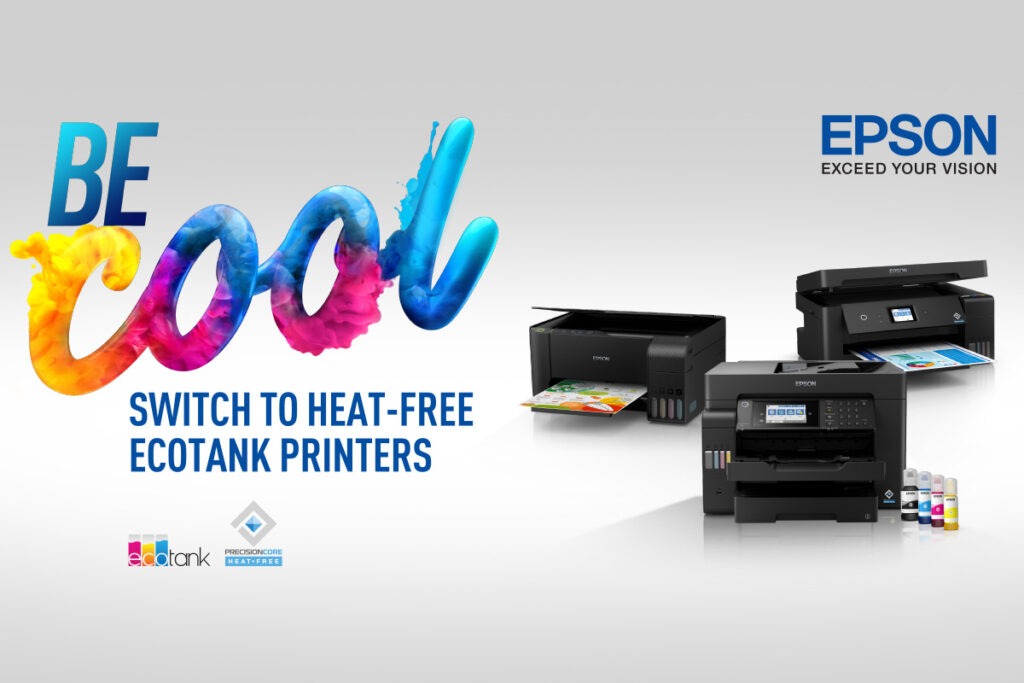
But the real innovation lies in Epson’s Heat Free Technology. Traditional laser printers require significant heat to fuse toner onto paper. This heating process consumes substantial electricity and necessitates warm up periods before printing can begin. Epson’s inkjet systems use piezoelectric crystals to precisely eject ink droplets without any heat requirement.
The energy savings are substantial. Epson’s Heat Free Technology uses up to 83% less energy than comparable laser printers. For a Gold Coast business operating multiple printers across an office, this translates to measurable electricity bill reductions. One Sydney business calculated annual savings of tens of thousands of dollars simply by switching from laser to Epson inkjet technology.
The performance characteristics matter too. Heat Free printers achieve instant warm up. Staff press print and documents emerge immediately, without the familiar delay while laser fusers heat to operating temperature. This responsiveness improves workflow efficiency in ways that don’t appear on specification sheets but make daily operations smoother.
Konica Minolta’s Carbon Neutral Journey
Konica Minolta took a different but equally ambitious approach to sustainability. The company committed to becoming carbon neutral, initially targeting 2050, then dramatically accelerating that goal to 2030. This twenty year timeline compression signals serious commitment backed by substantial investment.
Konica Minolta Australia has been carbon neutral for 17 consecutive years, demonstrating that carbon neutrality isn’t a future aspiration but a present achievement. The company reduced operational electricity consumption by 25% through strategic office relocations. They cut operational waste by 29% through cardboard reuse programmes and paper reduction initiatives. These aren’t token gestures. They’re fundamental operational changes embedded throughout the business.
The company’s environmental commitment extends beyond its own operations to the products it manufactures. Konica Minolta printers incorporate plant based toner components that significantly reduce carbon emissions during disposal compared to conventional petroleum based toners. The company designs devices for energy efficiency, incorporating intelligent power management that minimises consumption during idle periods without sacrificing responsiveness when printing is required.
Konica Minolta’s broader sustainability framework addresses three key areas. First, avoiding and reducing energy consumption through efficient design and operational practices. Second, substituting carbon emitting power sources with renewable energy across manufacturing and office facilities. Third, offsetting remaining emissions through verified carbon credit programmes while continuously working to reduce those emissions toward zero.
The company has received global recognition for these efforts. It ranks among the Global 100 Most Sustainable Corporations and holds a leadership position on the Climate A List. These aren’t purchased accolades. They’re earned through measurable environmental performance improvements verified by independent auditors.
For Gold Coast businesses, partnering with Konica Minolta means accessing technology designed with sustainability embedded from conception through end of life recycling. The printers deliver strong performance while supporting your own environmental commitments with credible, verified sustainability credentials.
Real Numbers from Real Businesses
Abstract environmental claims ring hollow without concrete examples. Let’s examine what Gold Coast businesses actually experience when they transition to sustainable printing solutions.
A Burleigh Heads accounting firm switched their eight laser printers to Epson WorkForce Pro devices two years ago. Their electricity consumption for printing dropped by 68%. That translated to $2,400 in annual electricity savings. They eliminated 96 toner cartridge replacements per year, saving another $3,200 in consumables costs. Total annual savings exceeded $5,600.
The environmental impact matched the financial savings. The firm reduced their printing related carbon emissions by approximately 2.1 tonnes annually. They diverted 15 kilograms of plastic cartridge waste from landfill. For a 12 person practice, these numbers might seem modest. But multiplied across thousands of similar businesses, the cumulative impact becomes substantial.
A Southport construction firm made a different calculation. They needed wide format printing capabilities for architectural drawings and tender documents. Traditional wide format solutions consumed enormous amounts of electricity and required frequent maintenance. They switched to Epson’s SureColor series using Heat Free Technology.
The energy savings were immediate. Their electricity costs for wide format printing dropped 55%. Maintenance requirements fell dramatically because the simpler inkjet mechanism has fewer wear components than complex laser systems. Print quality improved, with smoother gradients and more accurate colour reproduction for architectural visualisations.
The construction firm now prominently features their sustainability initiatives in tender submissions. Multiple clients have specifically commented on their commitment to environmental responsibility. The firm’s managing director credits their sustainable printing choice as a differentiator that helped secure contracts where environmental credentials influenced selection decisions.
A Varsity Lakes medical practice faced different requirements. They print thousands of patient records, referrals and Medicare claims daily. Print reliability is critical. Downtime disrupts patient care. Environmental impact wasn’t their primary concern. Cost control was.
They switched to Epson EcoTank printers for reception and administrative printing. The practice calculated they reduced per page costs by 87%. This seems impossible until you examine the numbers. Their previous laser printers cost approximately 8 cents per black and white page when factoring in toner, maintenance and energy. EcoTank systems brought that to under 1 cent per page.
For a practice printing 25,000 pages monthly, this difference equals $2,100 monthly savings, or $25,200 annually. The practice recovered their equipment investment in seven months. Everything afterward represented pure cost reduction. The environmental benefits emerged as a valuable bonus rather than the primary driver, though the practice now actively promotes their eco-friendly operations to environmentally conscious patients.
The Reputation Multiplier
Sustainability initiatives deliver benefits that extend beyond direct cost savings and environmental impact. They strengthen brand reputation and influence customer purchasing decisions in ways that are increasingly measurable.
Research shows 73% of consumers consider environmental sustainability when making purchasing decisions in 2026. For business to business transactions, that figure climbs higher. Procurement departments increasingly evaluate suppliers on environmental credentials, incorporating sustainability scores into vendor selection matrices.
Gold Coast businesses report tangible benefits from demonstrable environmental commitments. A Robina marketing agency won a local government contract partly because their sustainable printing practices aligned with council sustainability targets. The contract value exceeded $120,000 annually. The agency’s investment in sustainable printing equipment totalled $18,000. The return on that investment occurred in just two months.
The reputation benefits extend to employee recruitment and retention. Talented professionals, particularly younger workers, increasingly prioritise employers with genuine environmental commitments. A Surfers Paradise legal firm struggling to attract quality paralegals found their sustainable office initiatives, including eco-friendly printing, became compelling talking points during interviews. Three recent hires specifically mentioned the firm’s environmental credentials as factors influencing their decision to join.
Brand differentiation matters in competitive markets. When several businesses offer similar services at comparable prices, environmental credentials provide a differentiator that influences selection. This is particularly relevant for professional services where technical capabilities are difficult for clients to evaluate. Visible sustainability commitments signal broader operational excellence and forward thinking management.
The marketing value shouldn’t be underestimated. Businesses with genuine sustainability stories to tell leverage those stories across websites, social media, tender submissions and client presentations. A Broadbeach architecture firm features their sustainable printing practices in project proposals, positioning themselves as partners who understand and share clients’ environmental values.
This marketing leverage delivers measurable results. The architecture firm tracked enquiries mentioning environmental considerations and found a 34% increase over two years. While multiple factors influenced this trend, the firm’s enhanced environmental positioning clearly contributed to increased interest from sustainability focused clients.
The Technology Behind the Transformation
Understanding how sustainable printing technologies deliver superior results requires examining the engineering innovations driving these improvements.
Traditional laser printing technology hasn’t fundamentally changed in decades. Toner particles receive an electrostatic charge, transfer to paper, then permanent fusion occurs through heat and pressure. This process requires complex mechanical systems with multiple moving parts. Drums, transfer belts, fusers and cleaning blades all require periodic replacement. The heating element consumes substantial electricity and generates significant heat that must be managed through cooling systems.
Epson’s Heat Free Technology uses piezoelectric crystals that change shape when electrical current is applied. These microscopic shape changes precisely eject ink droplets onto paper. The process requires no heat, no warm up period and generates minimal mechanical wear. Fewer moving parts mean fewer maintenance requirements and longer operational life.
The environmental benefits cascade through the entire product lifecycle. Manufacturing piezoelectric print heads requires less energy intensive materials than laser printer assemblies. The simpler mechanical design uses fewer components, reducing raw material consumption and manufacturing complexity. The operational phase consumes dramatically less electricity. End of life disposal is simpler because fewer complex components require specialised recycling processes.
Konica Minolta’s approach focuses on intelligent design optimisation. Their Simitri HD toner melts at lower temperatures than conventional toners, reducing the energy required for fusing. This seemingly small change delivers measurable energy savings across millions of pages printed annually.
The company’s biomass toner initiative replaces petroleum based components with plant derived materials. This substitution reduces carbon emissions during manufacturing and disposal. The performance characteristics remain unchanged. Print quality, durability and archival properties match or exceed traditional toner formulations while delivering superior environmental credentials.
Modern sustainable printers incorporate intelligent power management that previous generations lacked. Devices enter deep sleep modes during idle periods, consuming negligible electricity while maintaining instant wake capability. Sophisticated sensors detect usage patterns and optimise power states accordingly. These systems deliver the responsiveness users demand while minimising energy waste during the substantial periods when printers sit idle.
The cumulative effect of these innovations transforms printing from an environmentally problematic necessity into a managed component of broader sustainability strategies. Businesses can achieve their printing objectives while simultaneously advancing environmental commitments rather than making compromises between these goals.
Implementation Without Disruption
The technical and financial cases for sustainable printing are compelling. The practical implementation determines whether businesses actually realise these benefits or stumble during transition.
Quality implementation starts with proper assessment. How many pages do you actually print monthly? What’s your colour versus monochrome ratio? Where are bottlenecks occurring? What are your true costs per page when all factors are included? Many businesses operate with impressions rather than data about their printing environment.
Professional assessment typically reveals surprises. One Gold Coast business believed they printed primarily black and white documents. Detailed tracking showed 40% colour usage, dramatically impacting their consumables costs. Another business assumed their three printers handled roughly equal volumes. Analysis revealed one device processed 65% of all jobs while the others sat largely idle. This imbalance created unnecessary maintenance costs and limited capability during peak periods.
Proper assessment enables right sizing solutions to actual needs rather than perceived requirements. A medical practice might need high speed black and white printing at reception for patient paperwork, moderate speed colour capability for educational materials and secure mobile printing for doctors working from tablets. One generic solution doesn’t optimise all these requirements. Targeted solutions deliver better results at lower total cost.
Transition planning prevents the disruption that undermines many sustainability initiatives. Nobody wants to champion an environmental programme that crashes during tax season or tender deadline week. Professional implementations happen in stages during low activity periods. One department transitions first, validating the approach before company wide rollout. Backup systems remain available during initial phases. Training happens before equipment changes rather than during crisis situations.
The human element matters enormously. Staff accustomed to familiar laser printers may resist change to inkjet technology based on outdated perceptions. Modern business inkjet systems deliver speeds, print quality and reliability that match or exceed laser performance. But overcoming preconceptions requires demonstration rather than assertion. Hands on exposure during training sessions builds confidence and prevents the quiet sabotage where resistant staff avoid new equipment.
Ongoing optimisation makes good initial implementations excellent long term solutions. Print needs evolve as businesses grow and change. Quarterly reviews examine usage patterns, identify new opportunities for improvement and adjust as requirements shift. A provider that installed equipment two years ago should proactively suggest improvements based on your current situation rather than simply maintaining what’s already in place.
DocSol’s Role in Gold Coast’s Green Transition
DocSol has facilitated sustainable printing transitions for Gold Coast businesses for over 20 years. This experience reveals patterns about what works and what doesn’t in practical implementation.
The company’s approach starts with genuine assessment rather than product pushing. Many businesses receive proposals recommending expensive equipment upgrades that happen to carry high commission rates for salespeople. DocSol’s assessment process examines actual usage data, identifies real problems and recommends solutions scaled to genuine needs rather than sales quotas.
This approach builds long term relationships rather than transactional equipment sales. When DocSol recommends Epson EcoTank systems for small office environments or Konica Minolta devices for high volume operations, businesses trust those recommendations are based on their specific requirements rather than profit maximisation for the vendor.
Local presence matters significantly for printing support. When a printer fails during a critical deadline, you need local technicians with parts stock and actual knowledge rather than a phone number routing to a call centre interstate. DocSol maintains Gold Coast based support staff who understand the unique requirements of local businesses.
The company has successfully transitioned dozens of Gold Coast businesses to sustainable printing solutions. These aren’t abstract environmental gestures. They’re practical business improvements delivering measurable cost savings alongside environmental benefits. The businesses range from small professional practices to large construction firms, medical centres to creative agencies.
DocSol’s relationship with major manufacturers like Epson and Konica Minolta ensures access to latest technology and favourable terms that individual businesses cannot negotiate independently. Volume purchasing power and established partnerships translate to better pricing and priority service for clients.
The ongoing support relationship proves its value during problems and upgrades. Technology evolves constantly. Requirements change as businesses grow. Having a trusted local partner who knows your environment and history makes navigating these changes smoother than repeatedly starting fresh with new vendors.
Taking Your First Steps
Transitioning to sustainable printing doesn’t require revolutionary upheaval. It starts with understanding your current situation and making incremental improvements that deliver immediate returns.
Begin by tracking actual printing behaviour for 30 days. Most businesses operate with vague impressions rather than concrete data. Install tracking software or manually log printing volumes, colour usage and common problems. This baseline data reveals opportunities that aren’t otherwise visible.
Calculate your true cost per page. Include equipment costs, consumables, maintenance contracts, energy consumption and staff time dealing with print issues. Most businesses significantly underestimate actual printing costs because hidden expenses don’t appear in obvious places.
Identify your most environmentally impactful printing practices. Are you printing single sided documents that could easily be duplex? Are marketing materials using excessive colour when simpler designs would suffice? Are staff printing emails that could remain digital? Small behaviour changes often deliver disproportionate environmental benefits.
Research sustainable alternatives appropriate for your volume and requirements. An office printing 1,000 pages monthly has different optimal solutions than one printing 20,000 pages. Don’t assume expensive enterprise solutions are necessary. Equally, don’t assume consumer equipment will survive business environments.
Talk to Gold Coast businesses in your industry who’ve already made the transition. What worked well? What unexpected problems emerged? Would they make the same choices again? Real world experiences from similar businesses provide valuable perspective that specification sheets cannot deliver.
Request detailed proposals that break down total cost of ownership over three to five years rather than just upfront equipment costs. Compare like with like by calculating cost per page across all scenarios. The cheapest initial purchase often proves most expensive long term.
Consider environmental credentials seriously but don’t let them override practical business requirements. Sustainable solutions must deliver reliable performance or they’ll be abandoned regardless of environmental benefits. The goal is finding options that simultaneously advance environmental and business objectives rather than requiring trade offs between them.
Plan implementation timing carefully around your business cycle. Don’t transition critical printing infrastructure during your busiest season. Allow learning periods when mistakes won’t create catastrophes. Build confidence with new systems before depending on them completely.
Document the results. Track cost savings, environmental improvements and any operational changes. These metrics justify the investment internally and provide compelling material for marketing your environmental commitments externally. Quantified results are far more credible than vague sustainability claims.
The Path Forward
Sustainable printing has moved from niche concern to mainstream business practice. The technologies delivering environmental benefits now simultaneously deliver superior financial performance compared to traditional alternatives. This convergence makes the transition straightforward for businesses willing to challenge outdated assumptions.
Gold Coast businesses adopting sustainable printing solutions report consistent patterns. Initial scepticism gives way to pleasant surprise at actual performance. Expected environmental benefits materialise alongside unexpected cost reductions. Brand reputation benefits emerge gradually but prove substantial over time.
The businesses leading this transition gain competitive advantages. They reduce operating costs, strengthen environmental credentials and position themselves as forward thinking organisations attuned to evolving market expectations. These advantages compound as environmental considerations increasingly influence purchasing decisions across all sectors.
The question isn’t whether sustainable printing makes business sense. The evidence clearly demonstrates it does. The question is whether your business will lead this transition or lag behind competitors already reaping these benefits. In an increasingly environmentally conscious market, the cost of inaction grows daily.
Ready to discover how sustainable printing can reduce your costs while strengthening your environmental credentials? Contact DocSol for a comprehensive assessment of your printing environment. We’ve helped dozens of Gold Coast businesses make this transition successfully. Your bottom line and the planet will both benefit.
Sources:
Epson Australia Sustainability Report 2024, Konica Minolta Carbon Neutral Initiatives, Grand View Research Australian Sustainable Printing Market Analysis, Office Equipment ESG Impact Studies, Australian Business Sustainability Statistics 2025